Updated September 22, 2026
When your magazine arrives after the game it previews, we understand your frustration. Timely coverage is central to your subscription, and we are adjusting our approach to help you receive useful information before kickoff. Our recent mailing records show substantial delays affecting even first-class copies. Federal oversight reports and independent mail-tracking data also document broader service problems.
What our latest mailing shows
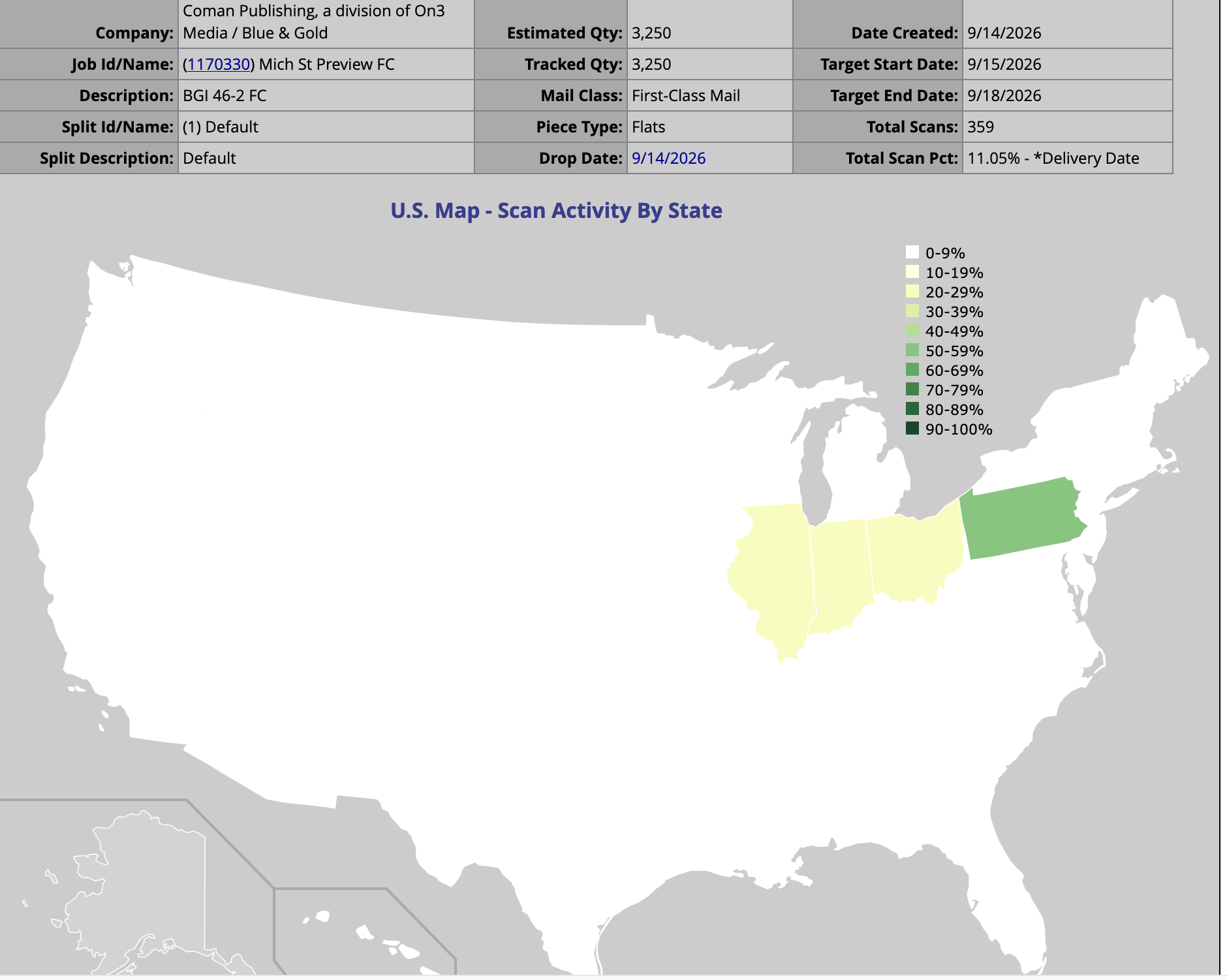
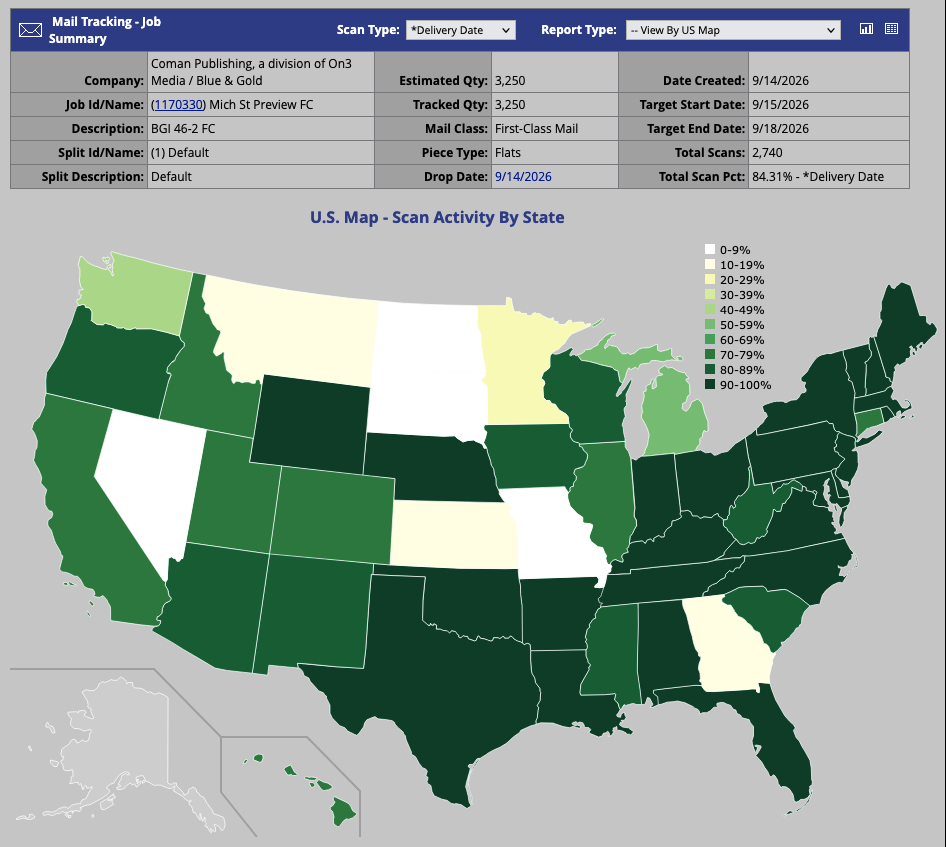
Our September 13 mailing of Blue & Gold Illustrated included 3,250 first-class copies of issue 46-2, featuring the Michigan State preview. The first recorded scan was September 14, as seen on the dashboard (click dates below to view delivery progress maps).
| Tracking snapshot | Copies with reported delivery activity | Percentage of mailing |
|---|---|---|
| September 19 | 359 of 3,250 | 11.05% |
| September 22 | 2,740 of 3,250 | 84.31% |
By September 22—nine calendar days after our Sunday mailing—510 copies still lacked reported delivery activity.
These figures reflect the tracking system’s “Delivery Date” report. They are not a direct count of subscribers confirming receipt, and scanning or reporting delays can affect the results. Nevertheless, they show why we cannot rely on postal delivery alone to provide time-sensitive coverage. Source: Blue & Gold Illustrated mailing-tracking captured September 19 and September 22, 2026.
First-Class flats have struggled in the Central postal area
Our first-class magazines travel as “flats,” the postal category for large envelopes and similar mail pieces. SnailWorks.com’ independent tracking reports show particularly weak performance for First-Class flats in the Central postal area, where our printer and many subscribers are located.
| Week beginning | Central-area on time | Avg. delivery days |
|---|---|---|
| August 31, 2026 | 6.9% | 6.64 |
| September 7, 2026 | 18.1% | 7.92 |
| September 14, 2026 | 44.8% | 5.00 |
Although performance improved across these three reports, fewer than half of tracked Central-area flats arrived on time in the latest week. These are SnailWorks sample results, not statistics for every USPS mailing or for our publication alone. Sources: September 7 report, September 14 report, September 21 report.
What has changed at USPS
USPS introduced its Delivering for America 10-year plan in 2021 to improve its finances and modernize its operations. Changes have included transportation, processing facilities and workforce management. Source: USPS Delivering for America.
Several developments help explain the changing delivery environment:
- More ground transportation. In October 2021, USPS lengthened delivery expectations for certain First-Class Mail by one or two days to accommodate a shift from air transportation to trucks. Source: GAO report.
- Processing consolidation. USPS has reorganized operations around regional and local processing centers. Its Inspector General found that difficulties implementing network changes negatively affected First-Class and Priority Mail performance. Source: USPS Inspector General review.
- Reduced transportation pickups at certain post offices. Under changes implemented in 2025, outgoing mail at affected locations more than 50 miles from a regional hub may wait until the following day’s transportation. This does not automatically apply to mail entered directly at regional processing centers or eligible presorted First-Class Mail. Source: USPS transportation rules.
- Reduced workhours and overtime. A federal audit found that overtime declined from 11.8% of mail-processing workhours in fiscal 2022 to 6.7% in fiscal 2024, with increased oversight of overtime approvals. Source: USPS Inspector General workhours audit.
Delivery standards are not delivery guarantees
USPS generally estimates First-Class Mail delivery in one to five business days, excluding Sundays and postal holidays. The applicable standard varies by route, and delivery by a specific date is not guaranteed. Source: USPS First-Class Mail guidance.
USPS does not guarantee Periodicals delivery within a specified time. Sources: Periodicals service standards, USPS delivery policy, Section 28.1.
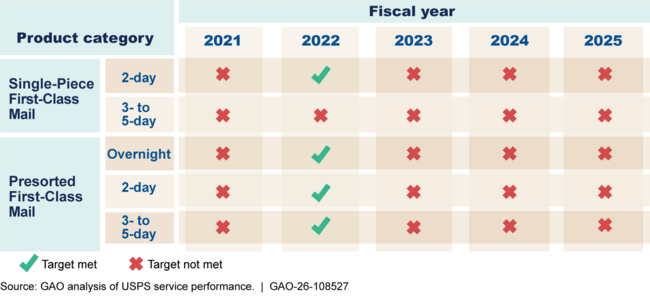
USPS has lowered some annual on-time performance targets. A September 2026 GAO report shows that it missed those targets in all five First-Class Mail categories examined in fiscal years 2023, 2024 and 2025. These targets measure the percentage of mail meeting its delivery standard—not whether every individual piece was late. Source: GAO report.
Why mailing dates and tracking dates can differ
A mailing date, a processing scan and a postmark do not necessarily represent the same event. USPS explains that an automated postmark generally reflects the first automated processing operation, which can occur after USPS initially receives an item. A postmark alone therefore may not show the full time an item has been in postal custody. Source: USPS postmark explanation. Source: USPS service-standard rules.